
Over 4.9 billion people worldwide use social media, making it one of the largest marketing channels.
Social media is not merely a content posting platform; it is now a strong business engine. Current brands demand actual outcomes, as opposed to likes and comments. This is where data-driven strategies come into play. Businesses are no longer relying on assumptions to make their decisions, but rather on insights, analytics, and real-time performance data to make informed choices.
Recent market research indicates that more than 80% of marketers believe that data-driven strategies effectively boost campaign performance and ROI. At the same time, companies that invest in analytics-based campaigns report higher engagement and conversion rates than traditional methods. This shift has made Social Media Marketing Companies more valuable than ever.
Data is the key to building a strong Social Media Presence. It helps brands understand what their audience wants, when they are most active, and how they engage with content. The result? Smarter campaigns, better targeting, and improved returns.
Know About Data-Driven Social Media Marketing?
Data-driven social media marketing is the process of using insights, analytics, and user behavior data to plan, execute, and optimize campaigns. Instead of guessing what might work, agencies rely on measurable information to create strategies that deliver results.
Traditional marketing often focused on broad messaging and limited targeting. In contrast, data-driven marketing allows businesses to personalize content, segment audiences, and refine campaigns continuously.
For example, when brands use Social Media for Brand Storytelling, data helps identify which stories resonate most with audiences. Whether it's emotional storytelling, product-focused content, or educational posts, analytics reveal what drives engagement and conversions.
This approach aligns closely with evolving Social Media Marketing Trends, where personalization, real-time engagement, and performance tracking are becoming standard practices.
Why Data-Driven Strategies Are Crucial for ROI
The final evaluation of success of any marketing campaign is the Return on Investment (ROI). Data-driven strategies are essential in enhancing ROI, as all decisions are supported with insights.
Accurate audience targeting is one of the biggest advantages. Instead of reaching a broad and uninterested audience, agencies focus on users most likely to convert. This helps reduce ad spend waste and improves efficiency.
Another key benefit is real-time optimization. Campaigns can be adjusted instantly based on performance data. If an ad is underperforming, agencies can modify visuals, messaging, or targeting to achieve better results.
Studies show that marketers using data-driven strategies are six times more likely to achieve higher ROI than those who do not. Additionally, campaigns optimized through analytics can improve conversions by up to 30%.
Data also helps brands understand customer behavior. By analyzing user interactions, businesses can create strategies that not only capture attention but also drive meaningful actions. This ultimately boosts awareness for your brand and leads to measurable growth.
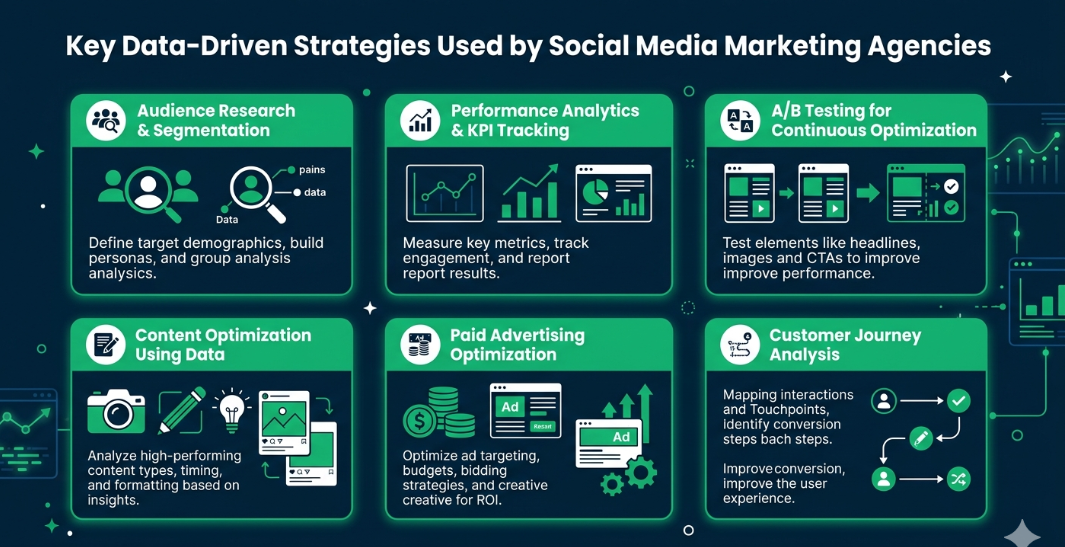
Key Data-Driven Strategies Used by Social Media Marketing Agencies
1. Audience Research & Segmentation
Any successful campaign is based on understanding the audience. The data is used to understand demographics, interests, online behavior and purchasing habits of the audience by social media marketing agencies.
Segmentation allows dividing viewers into particular groups depending on common features. This enables brands to provide very relevant content to every segment.
As an example, a fashion brand can have various audiences and can convey various messages to them: one is aimed at young fashionable users and another at those who want to have high-quality items. Such personalization raises the engagement and conversion rates.
According to market data, personalized campaigns have the potential to achieve 20% more sales than generic messages.
2. Performance Analytics & KPI Tracking
Agencies that are data-driven constantly measure the key performance indicators (KPIs) to understand the success of the campaign. These are engagement rate, click-through rate (CTR), conversion rate and customer acquisition cost.
Through measuring these metrics, agencies are in a good position to know what is working and what requires improvement. An example is when a campaign has a lot of engagement, but not much conversion, it could mean that the campaign had problems with the call-to-action or landing page.
The high-tech analytics tools give more specific information on the behavior of the users enabling the agencies to unify their strategies. Reports and dashboards can easily be used to monitor progress and to show ROI to clients.
Research indicates that customer acquisition is 23 times more likely to be successful in businesses that apply more advanced analytics as compared to rivals.
3. A/B Testing for Continuous Optimization
A/B testing is one of the most effective ways to improve campaign performance. It involves testing different variations of content—such as headlines, images, and CTAs, to determine which version performs better.
For example, an agency may run two versions of an ad with different visuals to see which generates more clicks. Based on the results, they can scale the winning version for maximum impact.
This approach eliminates guesswork and ensures that every element of the campaign is optimized for performance. Over time, continuous testing leads to better engagement, higher conversions, and improved ROI.
4. Content Optimization Using Data
Content plays a critical role in social media success, but not all content performs equally. Data helps agencies identify which types of content resonate most with their audience.
This includes analyzing factors such as:
- Content format (videos, images, carousels)
- Posting time and frequency
- Tone and messaging style
In the case of the brands that want to use Social Media to tell their Brand Stories, data shows the type of stories that resonate with users. It can be the behind-the-scenes content, customer story, product demonstrations or anything, but agencies rely on insights to create effective content strategies.
5. Paid Advertising Optimization
Paid social media advertising is a powerful tool for driving results, but it requires careful optimization to deliver a strong ROI.
Data-driven agencies use advanced targeting options to reach the right audience at the right time. They analyze performance data to allocate budgets effectively, ensuring that high-performing campaigns receive more investment.
Retargeting is another key strategy. By targeting users who have already interacted with a brand, agencies can increase the likelihood of conversions. Studies show that retargeted ads can boost conversion rates by up to 70%.
This strategic approach not only improves ROI but also strengthens overall Social Media Presence by consistently reaching relevant audiences.
6. Customer Journey Analysis
Understanding the customer journey is essential for optimizing conversions. Data helps agencies map out every touchpoint, from the first interaction to the final purchase.
By analyzing user behavior across platforms, agencies can identify where users drop off and take steps to improve the experience. For example, if users frequently abandon the process after clicking an ad, it may indicate issues with the landing page.
Customer journey analysis also supports personalized marketing. By delivering the right message at the right stage, brands can guide users through the funnel more effectively.
This approach not only improves conversions but also enhances customer satisfaction and brand loyalty.
Future of Data-Driven Social Media Marketing
Data and technology are closely related to the future of social media marketing. With the development of platforms, the role of data-driven strategies will only increase.
The manner in which campaigns are conducted is already changing due to the use of artificial intelligence and machine learning. These technologies are able to process huge amounts of data, recognize patterns and make predictions with a high degree of accuracy.
Personalization will be increasingly valued. Users are demanding content that is relevant to their needs and interests. Data will play a key role in delivering these customized experiences.
Predictive analytics is another emerging trend. By analyzing past behavior, agencies can anticipate future actions and develop proactive strategies. This helps brands stay ahead of the competition and maintain a strong Social Media Presence.
Data-driven strategies empower agencies to deliver measurable results, optimize campaigns, and maximize ROI. Businesses leveraging these insights can strengthen engagement, improve conversions, and build a powerful, growth-focused social media presence.